Introduction
Many people believe that building wealth is all about finding the “best” investment. They spend hours searching for the next multibagger stock, the top-performing mutual fund, or the latest investment trend. While choosing good investments is important, there’s another factor that often has a much bigger impact on long-term success: asset allocation.
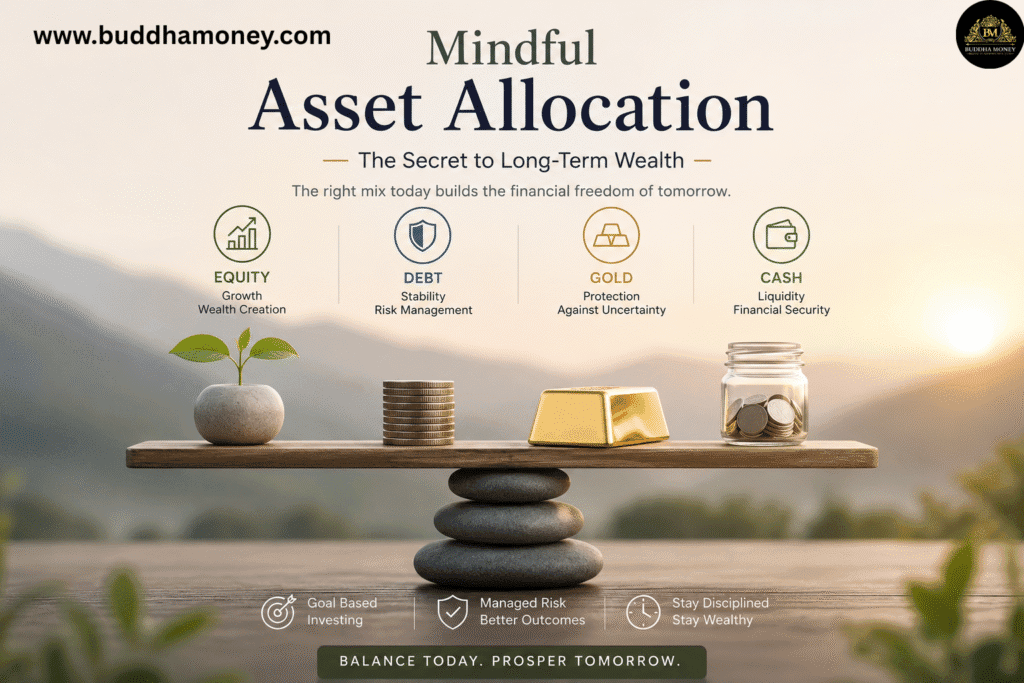
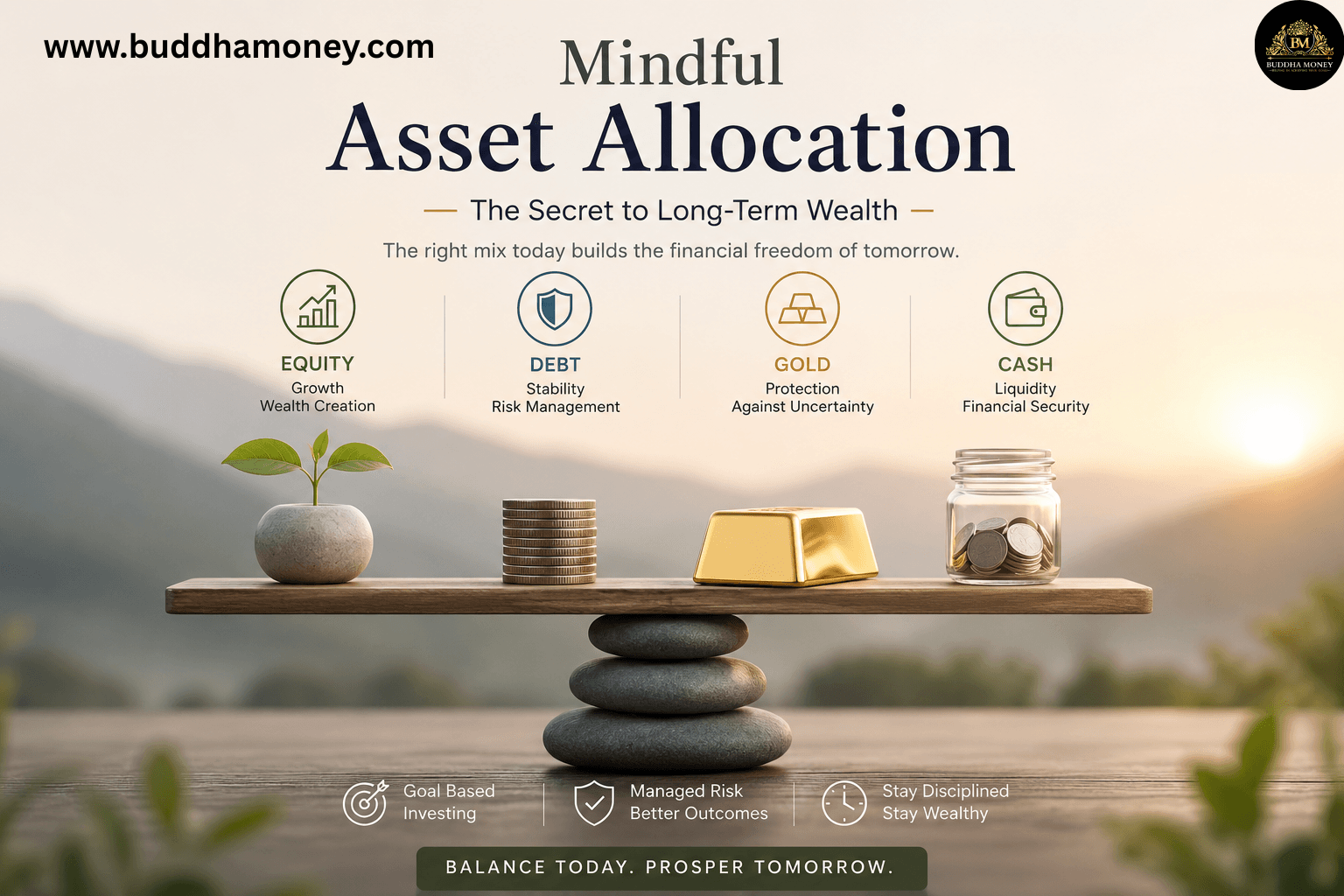
Asset allocation is the process of dividing your investments across different asset classes such as equity, debt, gold, and cash based on your financial goals, risk tolerance, and investment horizon. Rather than trying to predict which investment will perform best every year, mindful asset allocation focuses on creating a balanced portfolio that can perform consistently across different market conditions.
History has repeatedly shown that markets move in cycles. Sometimes equities outperform, while at other times debt, gold, or other assets take the lead. Investors who remain disciplined and maintain a diversified portfolio are generally better positioned to handle uncertainty and stay invested for the long term.
This is why many financial experts consider asset allocation to be one of the most important decisions in wealth creation.
What is Asset Allocation?
Asset allocation simply means deciding how much of your money should be invested in different types of assets.The major asset classes include:
1)Equity- Equity investments include stocks and equity mutual funds.
Purpose:
- Long-term wealth creation
- Beat inflation
- Capital appreciation
Risk Level: High
Suitable For: Long-term goals (7+ years)
2)Debt-Debt includes:
- Fixed Deposits
- Debt Mutual Funds
- Bonds
- Government Securities
- Treasury Bills
Purpose:
- Capital protection
- Stable income
- Lower volatility
Risk Level: Low to Moderate
Suitable for short to medium-term goals.
3)Gold-Gold acts as a portfolio diversifier.
It often performs well during periods of:
- Economic uncertainty
- High inflation
- Currency weakness
- Market volatility
Gold should generally not be the core investment but rather a supporting asset.
4)Cash and Liquid Investments-
Examples include:
- Savings Account
- Liquid Funds
- Emergency Fund
These provide liquidity and financial security.
Why Mindful Asset Allocation Matters
Asset allocation is not about maximizing returns every year.
It is about maximizing the probability of achieving your financial goals while managing risk effectively.
Think of your portfolio like a car.
- Equity is the engine.
- Debt is the brakes.
- Cash is the fuel reserve.
- Gold acts like shock absorbers during rough roads.
A car needs all of these components to reach its destination safely. Similarly, a portfolio requires a balance of different assets to navigate changing market conditions.
The Biggest Mistake Investors Make
Many investors unknowingly make one of these mistakes:
Investing only in Equity
During a bull market, investors often become overconfident.
They may allocate nearly all their investments to equities because recent returns look attractive.
However, when markets decline sharply, panic often leads them to sell at the worst possible time.
Investing only in Fixed Deposits
Some investors avoid market risk completely.
While this may feel safe, inflation gradually reduces the purchasing power of money.
For example:
If inflation averages 6% while your investment earns only 5%, your real wealth is actually declining over time.
Chasing Last Year’s Winners
Many people switch investments based on recent performance.
For example:
- Gold performs well → everyone buys gold.
- Equity performs well → everyone moves into stocks.
- Real estate rises → everyone rushes into property.
Unfortunately, markets usually reward discipline rather than chasing trends.
Asset Allocation Reduces Risk
Diversification works because different asset classes rarely move in the same direction at the same time.
For example:
| Market Situation | Equity | Debt | Gold |
| Strong Economy | High Returns | Moderate | Weak |
| Market Crash | Negative | Stable | Often Positive |
| High Inflation | Mixed | Moderate | Strong |
| Economic Slowdown | Weak | Better | Better |
Since no one can accurately predict the future, diversification helps reduce overall portfolio volatility.
The Role of Risk Tolerance
Every investor has a different comfort level with market fluctuations.
Ask yourself:
- How would I react if my portfolio fell by 20%?
- Can I stay invested during market volatility?
- Do I need this money in the next few years?
- What are my financial goals?
Your answers help determine the right asset allocation.
Asset Allocation Based on Life Stages
Young Investors (20–35 Years)
Investment Horizon:
Long
Possible Allocation:
- Equity: 70–80%
- Debt: 10–20%
- Gold: 5–10%
- Cash: Emergency Fund
Young investors generally have time to recover from market downturns and may benefit from higher exposure to growth assets.
Mid-Career Professionals (35–50 Years)
Goals often include:
- Children’s education
- Home purchase
- Retirement planning
Possible Allocation:
- Equity: 60–70%
- Debt: 20–30%
- Gold: 5–10%
The focus shifts toward balancing growth with stability.
Pre-Retirement Investors (50–60 Years)
Capital preservation becomes increasingly important.
Possible Allocation:
- Equity: 40–50%
- Debt: 40–50%
- Gold: 5–10%
Reducing portfolio volatility becomes a priority.
Retirees
Goals:
- Regular income
- Capital preservation
- Inflation protection
Possible Allocation:
- Debt: Higher allocation
- Equity: Moderate allocation
- Gold: Small allocation
- Adequate cash reserves
Even retirees often need some equity exposure to help their portfolio keep pace with inflation over a long retirement period.
Goal-Based Asset Allocation
Instead of investing randomly, align investments with specific financial goals.
Emergency Fund
- Liquid Funds
- Savings Account
Risk: Very Low
Buying a Car (2–3 Years)
- Debt Funds
- Short-Term Bonds
- Fixed Deposits
Risk: Low
Child’s Education (10–15 Years)
- Equity Mutual Funds
- Hybrid Funds
- Gradually shift to debt as the goal approaches
Retirement (20–30 Years)
A diversified portfolio with a higher equity allocation in the early years and a gradual increase in debt exposure over time.
What is Portfolio Rebalancing?
Over time, market movements change your original allocation.
Example:
Initially:
- Equity: 60%
- Debt: 40%
After a strong stock market rally:
- Equity: 75%
- Debt: 25%
Your portfolio is now taking more risk than originally planned.
Rebalancing means selling a portion of the asset class that has grown beyond its target and investing the proceeds into underweighted assets. This helps maintain your desired risk level and encourages the discipline of “buying low and selling high.”
Many investors review and rebalance their portfolios annually or when allocations drift significantly from their targets.
The Psychology Behind Asset Allocation
Mindful asset allocation also helps control emotions.
When markets rise sharply:
- Avoid excessive greed.
- Stay committed to your plan.
When markets fall:
- Avoid panic selling.
- Focus on long-term goals rather than short-term market movements.
A well-diversified portfolio can make it easier to remain invested during periods of volatility.
Common Asset Allocation Myths
Myth 1: More Equity Always Means Higher Wealth
Reality:
Higher equity exposure also brings higher volatility. The right allocation depends on your goals and ability to tolerate risk.
Myth 2: Fixed Deposits Are Always the Safest Choice
Reality:
While FDs offer capital stability, relying only on them may not adequately protect purchasing power against inflation over long periods.
Myth 3: Gold Doesn’t Belong in a Portfolio
Reality:
A modest allocation to gold can provide diversification benefits during periods of uncertainty.
Myth 4: Asset Allocation is Only for Large Investors
Reality:
Whether you invest ₹5,000 or ₹50 lakh, asset allocation plays a crucial role in managing risk and achieving long-term goals.
Practical Tips for Mindful Asset Allocation
- Define clear financial goals before investing.
- Build and maintain an emergency fund.
- Match your asset allocation to your time horizon and risk tolerance.
- Diversify across asset classes rather than relying on a single investment.
- Avoid making investment decisions based on market noise or recent performance.
- Review your portfolio at least once a year and rebalance when needed.
- Increase or reduce risk gradually as your life circumstances and goals change.
- Stay disciplined during both bull and bear markets.
Conclusion:
Long-term wealth creation is rarely about finding the perfect investment. It is about following a well-thought-out strategy and remaining consistent over time. Mindful asset allocation helps investors balance growth opportunities with risk management, making it easier to navigate changing market conditions without losing sight of their financial goals.
By spreading investments across appropriate asset classes, reviewing the portfolio periodically, and avoiding emotional decisions, investors can improve their chances of building sustainable wealth. Markets will continue to fluctuate, but a disciplined asset allocation strategy provides a framework for staying focused on what truly matters—achieving long-term financial security and financial independence.