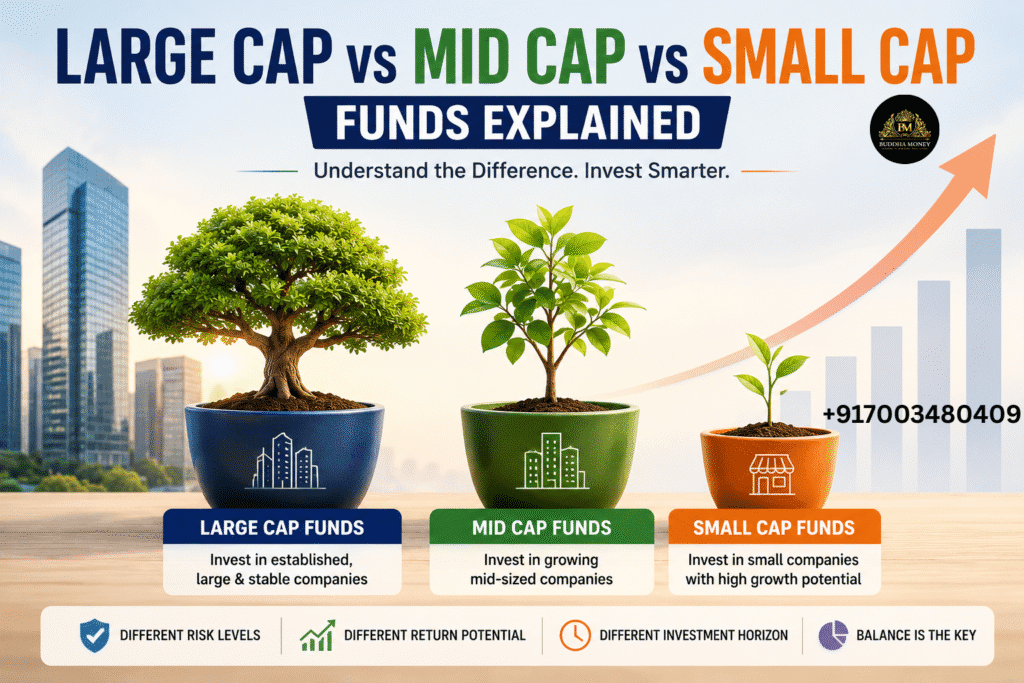
When people start investing in mutual funds, one of the first confusing questions they face is:
👉 Should I invest in Large Cap, Mid Cap, or Small Cap funds?
At first, these categories may sound technical, but understanding them is extremely important because they directly impact:
- Your returns
- Your investment risk
- Your long-term wealth creation
Many investors choose funds based only on recent performance without understanding how these categories actually work. This often leads to panic during market falls or unrealistic expectations during market rallies.
In this detailed guide, we’ll explain everything in simple language so you can clearly understand the difference between Large Cap vs Mid Cap vs Small Cap funds, their risks, benefits, and which type may suit your financial goals.
Understanding What “Cap” Means in Mutual Funds
The word “Cap” refers to Market Capitalization.
Market capitalization means the total value of a company in the stock market.
It is calculated as:
Share Price × Total Number of Shares
Based on company size, businesses are divided into:
- Large Cap companies
- Mid Cap companies
- Small Cap companies
Mutual funds invest in these different categories depending on their investment strategy.
What Are Large Cap Funds?
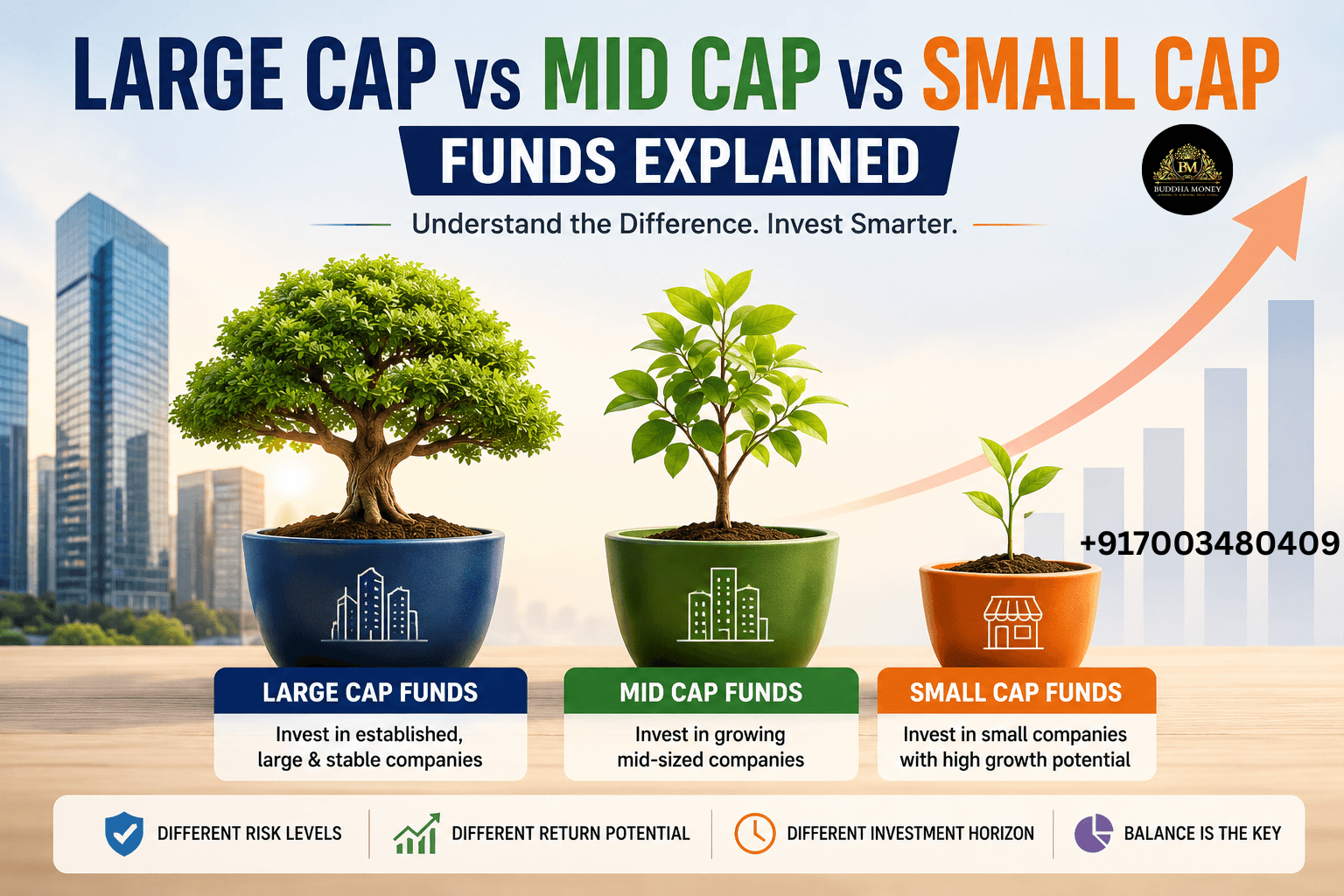
Large Cap funds invest in the top 100 companies in India based on market capitalization.
These are usually well-established companies with:
- Strong brand value
- Stable earnings
- Large customer base
- Long business history
Examples may include companies from sectors like banking, IT, FMCG, and energy.
Characteristics of Large Cap Funds
Large Cap funds are generally considered:
- More stable
- Less volatile
- Safer during market crashes
Since these companies are already large and mature, their growth is usually slower compared to smaller companies. However, they tend to recover faster during market downturns.
Who Should Invest in Large Cap Funds?
Large Cap funds are usually suitable for:
- Beginners
- Conservative investors
- People seeking relatively stable growth
- Long-term investors with moderate risk tolerance
If you are someone who gets uncomfortable with sharp market fluctuations, large cap funds may feel more manageable emotionally.
Advantages of Large Cap Funds
✔️ Lower Volatility
Large companies are generally more stable during economic uncertainty.
✔️ Stronger Stability
These companies usually have proven business models and financial strength.
✔️ Better for Beginners
Because risk is comparatively lower, many first-time investors start here.
Disadvantages of Large Cap Funds
❌ Slower Growth Potential
Since these companies are already very large, explosive growth becomes difficult.
❌ Lower Return Potential Compared to Smaller Segments
In strong bull markets, mid cap and small cap funds often outperform large caps.
What Are Mid Cap Funds?
Mid Cap funds invest in medium-sized companies ranked roughly between 101 and 250 by market capitalization.
These companies are usually in a growth phase:
- Expanding operations
- Increasing market share
- Building stronger business models
Mid cap companies often have more growth potential than large caps but also come with higher risk.
Characteristics of Mid Cap Funds
Mid Cap funds are known for:
- Higher growth opportunities
- Moderate-to-high volatility
- Better long-term return potential
They often perform very well during economic expansion phases.
Who Should Invest in Mid Cap Funds?
Mid Cap funds may suit:
- Investors with moderate-to-high risk tolerance
- Long-term investors
- People seeking higher growth than large caps
A longer investment horizon is important because mid caps can experience temporary sharp corrections.
Advantages of Mid Cap Funds
✔️ Strong Growth Potential
Mid-sized companies have room to grow into future large companies.
✔️ Better Return Possibilities
Historically, mid caps have often outperformed large caps over long periods.
Disadvantages of Mid Cap Funds
❌ Higher Volatility
Prices can fluctuate significantly during market uncertainty.
❌ Emotional Pressure
Many investors panic during corrections because volatility is higher.
What Are Small Cap Funds?
Small Cap funds invest in companies ranked below 250 in market capitalization.
These companies are smaller businesses with:
- High growth ambitions
- Limited market share
- Higher business risk
Small cap funds are considered the most aggressive among the three categories.
Characteristics of Small Cap Funds
Small cap funds are known for:
- Very high growth potential
- Extremely high volatility
- Higher risk during market downturns
These funds can generate exceptional returns during bull markets but may also fall sharply during corrections.
Who Should Invest in Small Cap Funds?
Small cap funds are generally suitable for:
- Aggressive investors
- Young investors with long investment horizons
- Investors comfortable with market fluctuations
Patience and emotional discipline are extremely important here.
Advantages of Small Cap Funds
✔️ Massive Growth Potential
Small companies can grow rapidly if their businesses succeed.
✔️ Wealth Creation Opportunity
Long-term investors can benefit significantly from compounding.
Disadvantages of Small Cap Funds
❌ Very High Risk
These funds can experience sharp declines during market crashes.
❌ Requires Strong Patience
Short-term volatility can be emotionally difficult.
Large Cap vs Mid Cap vs Small Cap: Key Differences
| Feature | Large Cap | Mid Cap | Small Cap |
| Risk Level | Moderate | High | Very High |
| Return Potential | Moderate | High | Very High |
| Stability | High | Medium | Low |
| Volatility | Lower | Moderate | Very High |
| Suitable For | Beginners | Growth Investors | Aggressive Investors |
| Investment Horizon | 5+ Years | 7+ Years | 10+ Years |
Which Category Performs Better?
This is one of the most searched questions among investors.
The reality is:
👉 No category performs best all the time.
- During uncertain markets → Large caps may perform better
- During growth phases → Mid caps may outperform
- During strong bull markets → Small caps may generate highest returns
Each category behaves differently depending on market conditions.
Should You Invest in Only One Category?
Not necessarily.
A balanced portfolio often combines:
- Stability from large caps
- Growth from mid caps
- High return potential from small caps
This creates diversification and reduces dependence on a single segment.
A Simple Strategy for Beginners
If you are confused, a simple allocation approach may help:
Conservative Investor
- Large Cap: Higher allocation
- Mid/Small Cap: Lower allocation
Moderate Investor
- Balanced mix of all categories
Aggressive Investor
- Higher exposure to mid & small caps
Common Mistakes Investors Make
❌ Chasing Recent Returns
Investors often rush into whichever category performed best recently.
❌ Ignoring Risk Capacity
High returns attract investors, but volatility scares them later.
❌ Exiting During Market Falls
Market corrections are common, especially in mid and small caps.
The Importance of Investment Horizon
Your time horizon matters greatly.
- Short-term investors may struggle with volatility
- Long-term investors benefit from compounding and recovery cycles
The longer you stay invested, the more effectively these categories can work.
Conclusion:
Understanding the difference between Large Cap vs Mid Cap vs Small Cap funds is essential for smarter investing.
There is no universally “best” category.
👉 The right choice depends on:
- Your risk tolerance
- Your financial goals
- Your investment horizon
- Your emotional comfort during volatility
Instead of chasing trends, focus on building a portfolio aligned with your personal financial journey.
Remember:
Successful investing is not about choosing the hottest category—it’s about staying invested with discipline and clarity.