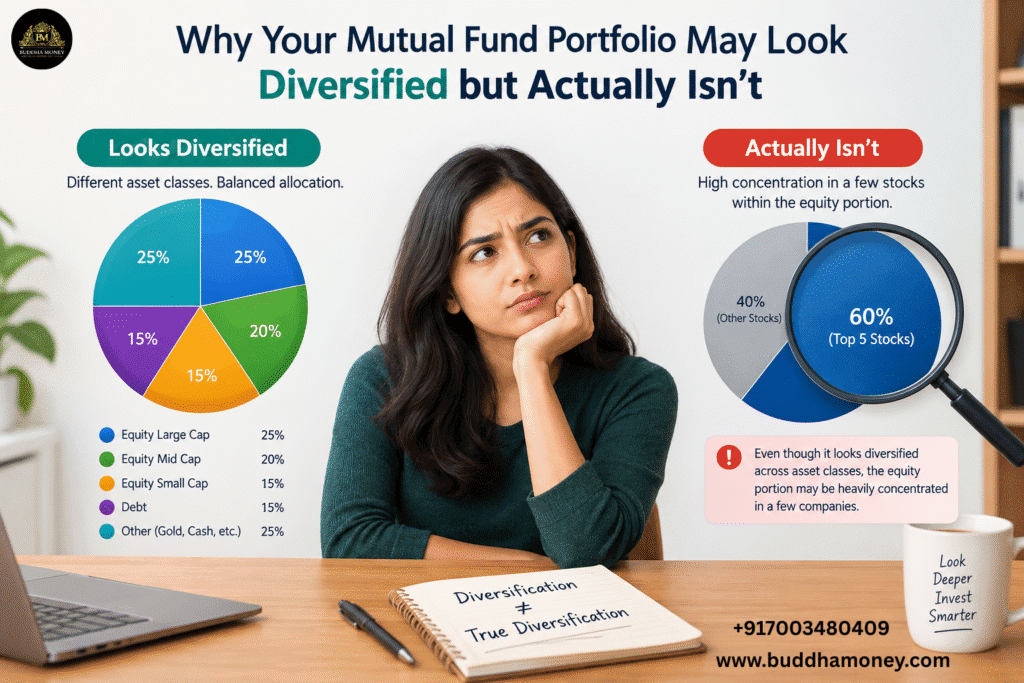
Why Your Mutual Fund Portfolio May Look Diversified but Actually Isn’t
Imagine an investor holding six different mutual funds.
One is a Large Cap Fund.
Another is a Flexi Cap Fund.
The third is a Mid Cap Fund.
Then there is a Value Fund, a Tax-Saving Fund and perhaps an Index Fund.
Looking at the portfolio, the investor feels reassured.
Six different schemes must mean six different sources of diversification.
Right?
Not necessarily.
There is a subtle but important distinction between owning multiple mutual funds and actually being diversified.
Two, three or even six mutual funds can have substantial exposure to many of the same companies and sectors. In such a situation, the investor may unknowingly be creating portfolio overlap rather than meaningful diversification.
This is one of the more overlooked aspects of mutual fund investing.
The problem isn’t that any individual fund is necessarily bad.
The problem is that the portfolio as a whole may be less diversified than it appears.
And that distinction matters.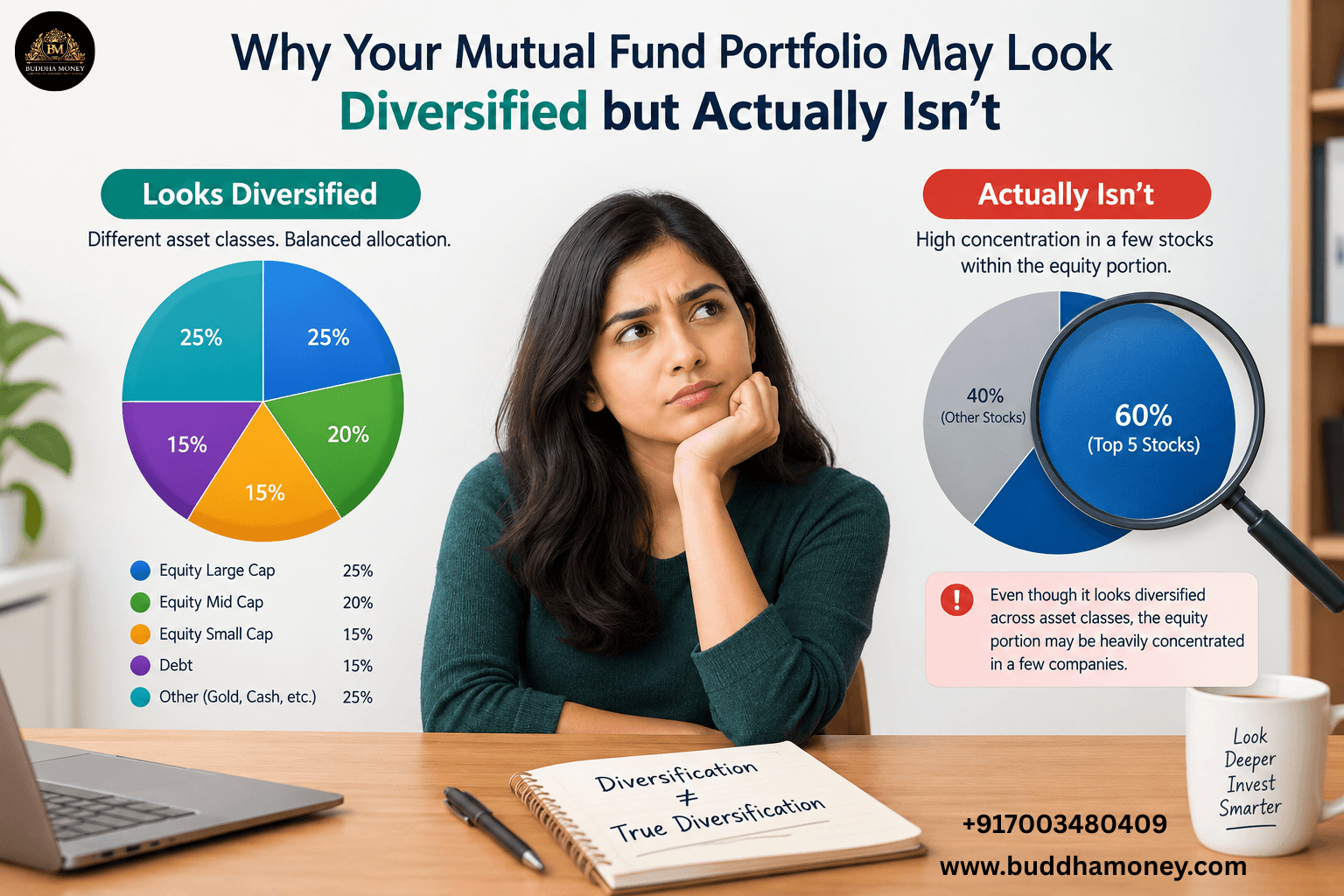
What Is Mutual Fund Portfolio Overlap?
Mutual fund portfolio overlap occurs when two or more mutual funds in an investor’s portfolio hold many of the same underlying securities.
For example, suppose an investor owns:
- Fund A
- Fund B
- Fund C
Each fund may have 50–70 stocks.
That sounds diversified.
But imagine all three funds have substantial allocations to the same large companies.
The investor may believe they own exposure to 150–200 different stocks.
In reality, the number of unique companies may be considerably lower.
This is known as portfolio overlap.
The overlap can occur at several levels:
Stock-level overlap
Different mutual funds hold the same companies.
Sector-level overlap
Different funds may have significant exposure to the same sectors.
Market-cap overlap
A portfolio may appear to contain Large Cap, Flexi Cap and Multi Cap funds while still having a substantial concentration in large companies.
Strategy overlap
Two funds may follow different labels but have surprisingly similar investment approaches.
Therefore, diversification should not be judged merely by the number of schemes you own.
It should be evaluated by understanding what those schemes actually own.
The “Six Mutual Funds = Diversification” Myth
Let’s take a hypothetical investor named Rahul.
Rahul invests:
₹10,000 in Fund A
₹10,000 in Fund B
₹10,000 in Fund C
₹10,000 in Fund D
₹10,000 in Fund E
₹10,000 in Fund F
His total monthly investment is ₹60,000.
He proudly says:
“I have six mutual funds, so my portfolio is well diversified.”
But suppose several of those funds hold many of the same large companies.
The investor may have six schemes but a considerably smaller number of genuinely distinct exposures.
This is why scheme count is a poor proxy for diversification.
A portfolio containing ten funds can sometimes be less diversified than a carefully constructed portfolio containing four or five complementary funds.
Why Does Mutual Fund Overlap Happen?
There are several reasons.
Popular Companies Appear Across Multiple Funds
Fund managers operate within the same market.
Large, established companies naturally appear in many portfolios.
If an investor owns several equity-oriented funds, some common holdings are almost inevitable.
The issue is not whether there is any overlap.
The issue is whether the overlap becomes excessive or unintended.
Investors Keep Adding New Funds Without Reviewing Existing Ones
This is extremely common.
An investor already owns three mutual funds.
Then a friend recommends another.
A financial website highlights a top-performing fund.
A social media video talks about a “best mutual fund.”
Another fund is added.
After a few years, the investor has eight or ten schemes.
But nobody has examined whether the new investments actually add something meaningful to the existing portfolio.
The portfolio grows in size—but not necessarily in quality.
Chasing Past Performance
Suppose Fund A delivered exceptional returns last year.
The investor buys it.
A few months later, another fund appears at the top of the performance table.
The investor buys that too.
Eventually, the portfolio becomes a collection of recently successful funds rather than a carefully constructed investment strategy.
This is often referred to as performance chasing.
The investor is collecting yesterday’s winners without asking whether each fund has a distinct role in the portfolio.
An Example of Hidden Overlap
Consider a hypothetical portfolio containing four funds.
| Fund | Category | Example of Common Exposure |
| Fund A | Large Cap | Company X, Company Y |
| Fund B | Flexi Cap | Company X, Company Z |
| Fund C | Mid Cap | Company Y, Company Z |
| Fund D | Multi Cap | Company X, Company Y |
At first glance, this looks like four different funds.
But several of the same companies appear repeatedly.
Now imagine that Company X represents:
- 7% of Fund A
- 6% of Fund B
- 5% of Fund D
If the investor allocates equally to all three funds, their effective exposure to Company X is much larger than they may realise.
This is why simply reading the fund names isn’t enough.
You need to look through the labels and examine the underlying holdings.
Diversification Doesn’t Mean Owning Everything
There is another misconception worth addressing.
Some investors believe:
“The more funds I own, the safer my portfolio becomes.”
This isn’t necessarily true.
Diversification is not about collecting as many investments as possible.
It is about spreading risk intelligently across investments that do not behave identically.
Imagine a dinner plate containing ten different foods—but nine of them are essentially the same dish.
The plate looks varied.
The underlying composition isn’t.
Mutual fund portfolios can behave similarly.
A portfolio with several funds may still have significant concentration in the same companies, sectors or market segments.
What Is Genuine Diversification?
Genuine diversification involves creating a portfolio where different components have distinct and complementary roles.
Depending on the investor’s objectives, this may involve diversification across:
- Asset classes
- Market capitalisations
- Investment styles
- Sectors
- Geographies
- Risk levels
- Investment horizons
However, diversification should always be appropriate to the investor.
More diversification isn’t automatically better.
Appropriate diversification is better than excessive diversification.
Mutual Fund Overlap vs Asset Allocation
These two concepts are related but not identical.
Portfolio overlap
Focuses primarily on how much the underlying holdings of different investments coincide.
Asset allocation
Focuses on how your overall portfolio is divided across asset classes such as:
- Equity
- Debt
- Cash
- Gold
- Other suitable investments
An investor could have five equity mutual funds with minimal stock-level duplication but still have an excessively aggressive portfolio because almost all their money is invested in equity.
Conversely, someone could have several funds with significant overlap but also maintain a substantial debt allocation.
Therefore, diversification and asset allocation should be evaluated separately.
How to Check Mutual Fund Portfolio Overlap
Investors don’t have to rely solely on fund names.
A basic review can involve comparing the portfolio holdings of the mutual funds you own.
Step 1: List all your mutual funds
Write down every scheme you currently hold.
Don’t leave out old investments simply because you stopped the SIP.
An existing investment remains part of your portfolio.
Step 2: Identify the major holdings
Look at the top holdings of each fund.
Pay particular attention to companies that appear repeatedly.
Step 3: Compare sector exposure
Two funds may have different names but substantial exposure to the same sectors.
For example, both may have significant allocations to financial services, information technology or energy.
Step 4: Examine market-cap exposure
Don’t assume that a Flexi Cap or Multi Cap Fund automatically creates a completely different portfolio from your Large Cap Fund.
There may still be considerable overlap.
Step 5: Look at the portfolio as a whole
This is the most important step.
Don’t evaluate every mutual fund in isolation.
Ask:
“What does my entire portfolio actually look like?”
That is where hidden concentration becomes visible.
How Much Mutual Fund Overlap Is Too Much?
There is no universal percentage that applies to every investor.
A certain degree of overlap is normal.
Two diversified equity funds can naturally own some of the same companies.
The important question is:
Does the overlap serve a purpose?
If two funds have substantial common holdings and essentially perform the same role in your portfolio, owning both may not add much diversification.
However, if two funds have some overlap but different mandates, risk profiles or strategic roles, the overlap may be perfectly reasonable.
Therefore, blindly applying a fixed “overlap limit” can be misleading.
Context matters.
Does Overlap Mean You Should Sell One of the Funds?
Not automatically.
This is where investors often make another mistake.
They discover overlap and immediately think:
“I should sell one of these funds.”
But the correct response requires a broader assessment.
Consider:
- Why was each fund originally selected?
- What role does each fund play?
- How significant is the overlap?
- Is one fund redundant?
- What are the tax implications of selling?
- Is there an exit load?
- How long have you held the investment?
- Does the investment still fit your financial objective?
- Would consolidation actually improve the portfolio?
Sometimes the answer may be to consolidate.
Sometimes both funds may have a legitimate role.
The objective is not to eliminate overlap at all costs.
The objective is to avoid unintended concentration and unnecessary duplication.
Why Too Many Mutual Funds Can Make Portfolio Management Difficult
There is another practical problem with excessive diversification: complexity.
Imagine an investor holding 12 mutual funds.
Every month, multiple SIPs are deducted.
Every year, there are numerous statements to review.
Different funds have different performance patterns.
Some may overlap heavily.
Others may be redundant.
Eventually, the investor may struggle to answer a simple question:
“Why exactly do I own this fund?”
That is a warning sign.
A well-structured portfolio should be understandable.
You should ideally know:
What you own.
Why you own it.
What goal it serves.
How much risk it carries.
When you expect to need the money.
If you cannot answer those questions, the number of funds may have become more important than the investment strategy.
More Funds Don’t Necessarily Mean More Returns
This deserves emphasis.
Adding another mutual fund does not automatically increase expected returns.
Returns are driven by the underlying investments and market conditions—not by the number of scheme names appearing in your portfolio.
If Fund A and Fund B hold largely similar companies, adding Fund B may simply increase your exposure to the same underlying risks.
In other words:
More funds ≠ automatically more diversification
and
More diversification ≠ automatically higher returns.
The purpose of diversification is primarily to manage concentration and risk—not to manufacture returns.
Portfolio Overlap Can Also Affect Risk During Market Corrections
Suppose an investor owns several funds.
During a market correction, the investor expects the funds to behave differently because they belong to different categories.
But if those funds have substantial exposure to the same companies or sectors, they may decline together.
This can create an unpleasant surprise:
“I thought I had diversified across several funds. Why are all of them falling together?”
The answer may lie in the underlying holdings.
A portfolio is not diversified merely because its investments have different names.
What matters is how those investments behave and what they actually own.
Should Beginners Own Multiple Mutual Funds?
There is no universal number that works for everyone.
A beginner with a relatively small portfolio may not need a large collection of schemes.
Starting with a manageable number of carefully selected investments can make portfolio monitoring considerably easier.
As the portfolio grows and financial goals become more sophisticated, additional investments may become appropriate.
But every new fund should answer a simple question:
“What does this fund add that I don’t already have?”
If the answer is unclear, adding it may simply increase complexity.
Different Financial Goals May Justify Different Investments
There is, however, a legitimate reason for holding different investments.
You may have several financial objectives:
Goal 1: Child’s Education
Time horizon: 10 years
Goal 2: Retirement
Time horizon: 20 years
Goal 3: Home Purchase
Time horizon: 5 years
The appropriate investment strategy for each goal may differ because the time horizon and risk capacity are different.
This is where goal-based investing becomes more meaningful than simply searching for the “best mutual fund.”
Instead of asking:
“Which fund gave the highest return?”
Ask:
“Which investment strategy is appropriate for this specific goal?”
That is a far more useful question.
A Simple Portfolio Review Framework
If you want to determine whether your mutual fund portfolio is genuinely diversified, review these five dimensions:
- Scheme Count
How many funds do you actually own?
- Underlying Holdings
How many common companies appear across those funds?
- Sector Exposure
Are you disproportionately dependent on particular sectors?
- Asset Allocation
How much of your overall portfolio is in equity, debt and other assets?
- Goal Alignment
Does every significant investment have a clear purpose?
If you can answer all five, your portfolio is already likely to be more thoughtfully constructed than one based purely on fund rankings.
The Difference Between Diversification and Diworsification
There is a useful investment concept known as diworsification.
It describes a situation where an investor keeps adding investments without meaningfully improving the portfolio.
At some point, additional holdings may contribute more complexity than diversification.
For example:
3 complementary funds → potentially sensible
7 carefully selected funds → potentially sensible
15 funds accumulated through recommendations, advertisements and performance chasing → worth reviewing
The exact number isn’t the issue.
The underlying structure is.
When Should You Review Your Mutual Fund Portfolio?
Portfolio review shouldn’t happen only when markets crash.
A periodic review can help identify:
- Excessive overlap
- Unnecessary duplication
- Changes in risk tolerance
- Changes in financial goals
- Over-concentration
- Outdated investments
- Asset allocation drift
A review also becomes particularly important after major life events such as:
- Marriage
- Birth of a child
- Career change
- Significant increase in income
- Business transition
- Approaching retirement
- Major change in financial responsibilities
Your portfolio should evolve as your financial life evolves.
Five Questions to Ask Before Adding Another Mutual Fund
Before starting another SIP, pause for a moment and ask:
- What problem is this fund solving?
- Do I already own something that performs a similar role?
- How different are its underlying holdings?
- Does it align with one of my financial goals?
- Will this addition genuinely improve my portfolio—or simply make it larger?
If you cannot clearly answer these questions, waiting may be wiser than adding another fund impulsively.
The Bigger Lesson: A Portfolio Is More Than a Collection of Funds
One of the most persistent misconceptions in mutual fund investing is that portfolio construction is simply about selecting a list of good funds.
It isn’t.
A portfolio is an ecosystem of investments.
Each component interacts with the others.
One fund may provide growth exposure.
Another may complement a particular market segment.
Another may serve a different financial objective.
Debt investments may provide stability.
The quality of the portfolio therefore depends not only on the quality of individual investments but also on how those investments fit together.
A collection of excellent funds can still create an inefficient portfolio if they duplicate one another unnecessarily.
Final Thoughts
Mutual fund diversification is not a numbers game.
Owning ten schemes doesn’t automatically make you diversified, just as owning three schemes doesn’t automatically make you concentrated.
The real question is:
What do you actually own beneath those fund names?
Two seemingly different funds may have substantial common exposure.
Three different categories may still lean heavily towards the same companies.
A portfolio with numerous SIPs may still be exposed to the same underlying market risks.
This is why investors should periodically look beyond the surface and examine the architecture of their portfolio.
The objective isn’t to eliminate every instance of overlap.
Nor is it to keep adding funds in the pursuit of perfect diversification.
The objective is to build a portfolio where every investment has a clear purpose, a defined role and a meaningful relationship with your financial goals.
Ultimately, good portfolio construction is less about owning more and more about owning with intention.
Because when it comes to investing, a crowded portfolio isn’t necessarily a diversified portfolio.
It may simply be a portfolio that needs a closer look.
Frequently Asked Questions About Mutual Fund Portfolio Overlap
What is mutual fund portfolio overlap?
Mutual fund portfolio overlap occurs when two or more mutual funds hold many of the same underlying securities. Significant overlap can reduce the diversification benefit an investor expects from owning multiple funds.
Is mutual fund overlap always bad?
No. Some overlap is natural because different funds may invest in the same leading companies. The concern arises when the overlap is substantial, unintended and doesn’t add meaningful diversification.
How can I check mutual fund overlap?
You can compare the underlying holdings and sector allocations of the mutual funds you own. A portfolio review can also help identify repeated exposures and unintended concentration.
How many mutual funds should I own?
There is no universal number. The appropriate number depends on your investment goals, portfolio size, asset allocation, risk profile and investment strategy. More funds do not automatically mean better diversification.
Should I sell a mutual fund if it overlaps with another fund?
Not necessarily. Before making a decision, consider the purpose of each fund, degree of overlap, tax implications, exit load, investment horizon and whether one investment has become redundant.
Does owning different mutual fund categories guarantee diversification?
No. Different categories can still have overlapping holdings or similar market exposure. Investors should evaluate the actual portfolio composition rather than relying solely on fund labels.
Why is too much mutual fund overlap a problem?
Excessive overlap can create unintended concentration. If several funds depend heavily on the same companies or sectors, the portfolio may behave more like a concentrated investment than a genuinely diversified one.
Key Takeaways
- More mutual funds do not automatically mean more diversification.
- Portfolio overlap occurs when different funds hold many of the same underlying securities.
- Some overlap is normal and not necessarily problematic.
- Excessive or unintended overlap can create hidden concentration.
- Fund names and categories alone do not reveal the complete risk of a portfolio.
- Asset allocation and portfolio overlap are different concepts and should be reviewed separately.
- Every mutual fund should ideally have a clear purpose within the portfolio.
- Avoid adding funds simply because they have recently performed well.
- Review your entire portfolio rather than evaluating each fund in isolation.
- The goal is not to own the maximum number of funds—it is to build a coherent, goal-aligned portfolio.
Disclaimer: Mutual fund investments are subject to market risks. Read all scheme-related documents carefully before investing. Past performance does not guarantee future returns. The information provided in this article is for educational purposes only and should not be construed as investment advice. Investment decisions should be made after considering individual financial goals, risk tolerance, investment horizon and overall financial circumstances.