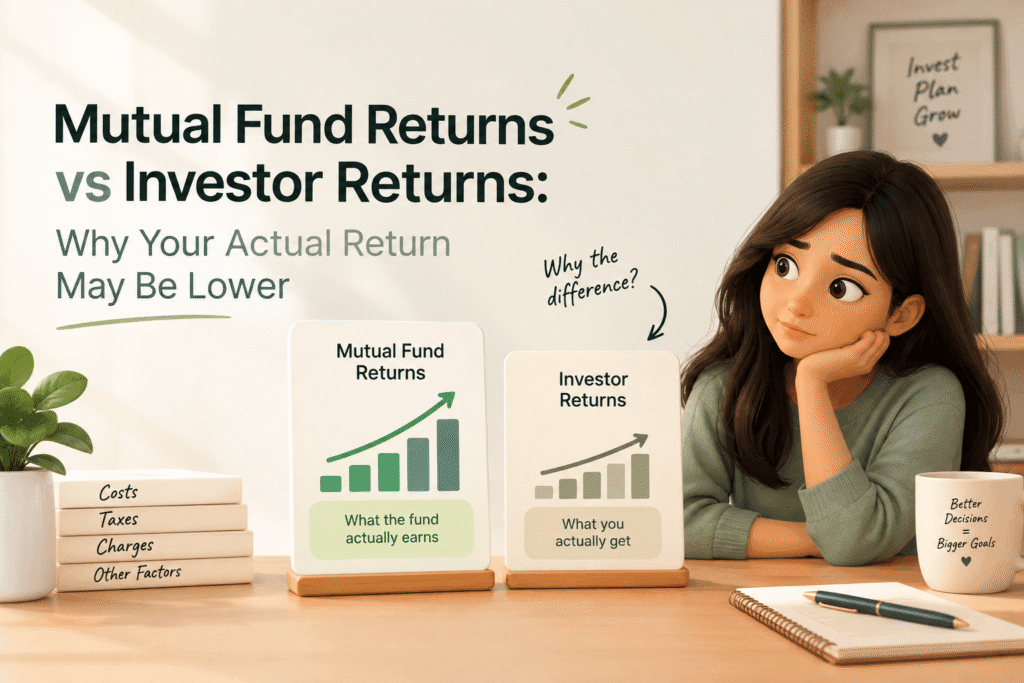
Your Mutual Fund Made 14%. Why Doesn’t Your Portfolio Show 14%?
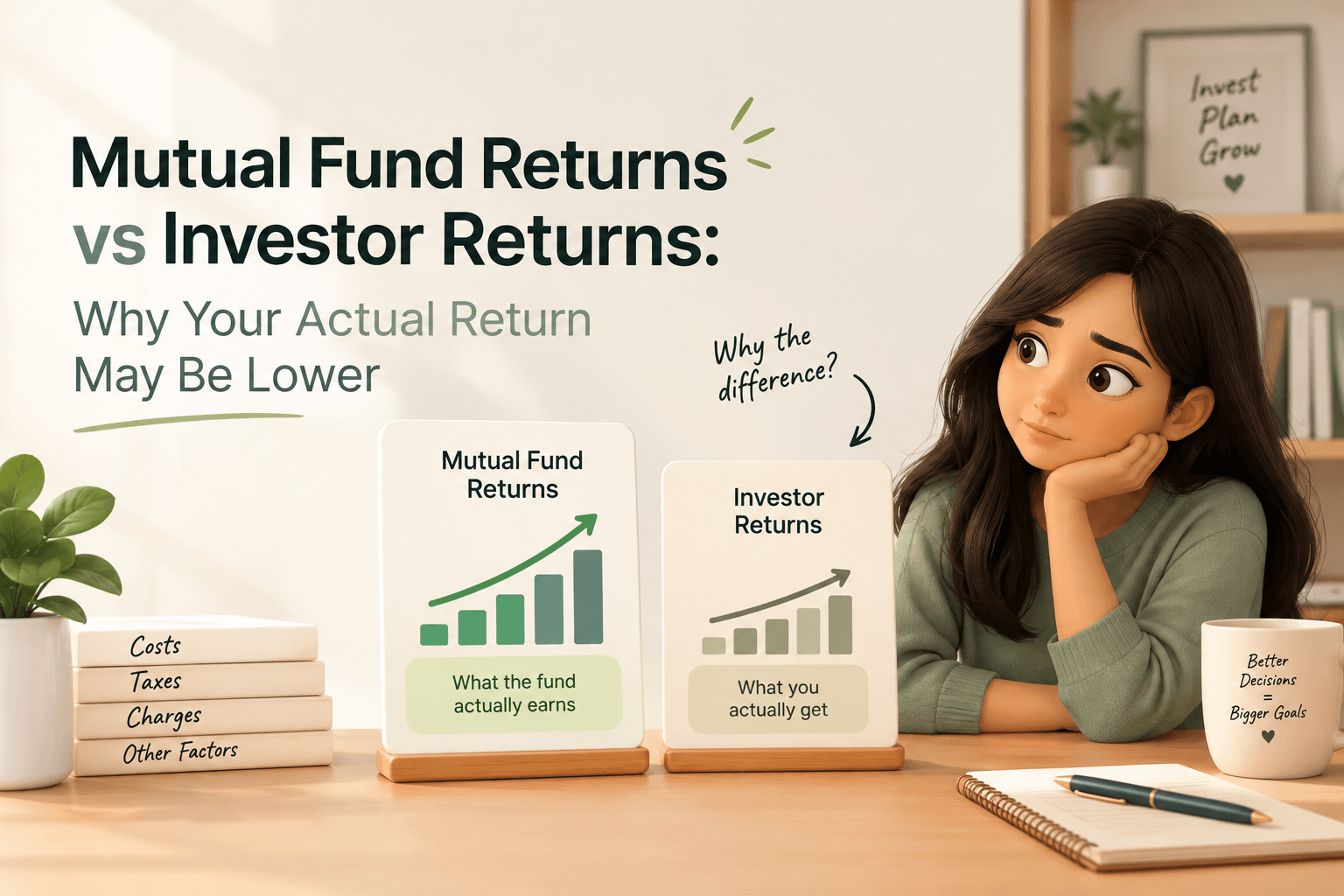
This is one of the most frustrating experiences for investors.
You open your mutual fund app and see that the scheme has delivered 14% annualized returns over a particular period.
You look at your own portfolio and think:
“I have been invested in the same fund. So why am I earning only 9.8%?”
It is tempting to conclude that something is wrong.
Maybe the fund house calculated the return incorrectly.
Maybe the app is showing the wrong number.
Maybe the mutual fund did not actually perform as advertised.
Usually, none of these is the real reason.
The important distinction is this:
A mutual fund’s return describes the performance of the investment portfolio over a specified period. Your return describes the experience of your actual money invested over time.
And those two numbers can be very different.
This difference becomes particularly important when you invest through SIPs, make additional purchases, redeem partially, stop and restart investments, or invest large amounts at different points in the market cycle.
Let’s understand why.
Fund Return and Investor Return Are Two Different Things
Suppose a mutual fund reports a 14% annualized return over five years.
That number tells you how the fund performed during that measurement period.
But imagine that you invested:
- ₹10,000 per month through SIP
- started three years after the fund’s five-year measurement period began
- increased your SIP later
- made an additional lump-sum investment during a market rally
Your money did not participate in the fund’s entire five-year journey in the same way.
Some of your money may have been invested for three years.
Some for two years.
Some for only a few months.
Therefore, simply comparing the fund’s five-year return with your personal portfolio return can be misleading.
Think of it this way:
Fund return = How the investment performed.
Investor return = How your actual money experienced that performance.
That distinction explains a lot of apparently mysterious portfolio numbers.
A Simple Example
Let’s take a hypothetical example.
Suppose Fund A delivered approximately 14% annualised returns over a particular period.
Investor A invested ₹10 lakh as a lump sum at the beginning of that period.
If the investment remained untouched for the entire period, Investor A’s return may be reasonably close to the fund’s reported return, subject to the exact return methodology and expenses/timing involved.
Now consider Investor B.
Investor B did not invest ₹10 lakh on day one.
Instead, Investor B invested:
- ₹10,000 every month through SIP
- increased the SIP after two years
- added ₹2 lakh during a market rally
- redeemed ₹1 lakh later for a personal requirement
Investor B’s money entered and exited the fund at different points.
Therefore, Investor B’s return cannot simply be assumed to be 14%.
The underlying fund could have performed very well, while Investor B’s actual annualised return could be materially different.
The fund did not necessarily perform differently for Investor B. The cash-flow pattern was different.
SIP Investors Experience the Market Differently
This becomes even more important with SIPs.
When you invest through SIP, you are not putting all your money into the market on one particular day.
You are making multiple investments.
For example:
| Month | SIP | Market Situation |
| January | ₹10,000 | Market relatively high |
| February | ₹10,000 | Market falls |
| March | ₹10,000 | Market falls further |
| April | ₹10,000 | Market volatile |
| May | ₹10,000 | Market recovers |
| June | ₹10,000 | Market rises |
Each ₹10,000 installment purchases units at a different NAV.
That means every installment has a different investment date and potentially a different holding period.
This is one reason why an investor’s return cannot be understood properly by simply looking at the fund’s headline return.
This Is Where XIRR Becomes Important
If you invest a lump sum once and leave it untouched, CAGR can be a useful way to express annualised growth.
But SIP investors have multiple cash flows.
You may have:
- 60 SIP installments
- an occasional additional investment
- a partial redemption
- another lump sum
- perhaps a switch between schemes
Now there isn’t one single investment date.
This is where XIRR becomes particularly useful.
XIRR considers:
the amount invested + the exact date of each cash flow + the current value or redemption value.
So if you want to understand what your own SIP portfolio actually earned, XIRR is generally more meaningful than simply looking at the fund’s CAGR.
In simple terms:
CAGR asks:
“How much did this investment grow annually over the period?”
XIRR asks:
“What annualised return did my actual money earn, considering when I invested and withdrew money?”
For an investor making multiple cash flows, that distinction matters.
- The Timing of Your Investments Can Change Your Experience
Consider a hypothetical fund whose NAV moves like this:
| Year | NAV |
| Year 1 | ₹100 |
| Year 2 | ₹125 |
| Year 3 | ₹95 |
| Year 4 | ₹120 |
| Year 5 | ₹145 |
The fund eventually reaches ₹145.
But investors who entered during different years experienced very different journeys.
An investor who invested at ₹95 had a completely different starting point from someone who invested at ₹125.
This is why the starting point and cash-flow pattern matter.
A fund can generate attractive long-term returns while individual investors experience different returns depending on when and how they invested.
- Market Corrections Can Actually Change Your SIP Experience
This is one of the most misunderstood aspects of SIP investing.
Suppose you are investing ₹20,000 every month.
The market falls 15%.
Your portfolio value may decline.
It feels uncomfortable.
But your next ₹20,000 SIP now purchases more units because NAVs are lower.
For example:
| NAV | SIP | Approx. Units Purchased |
| ₹100 | ₹20,000 | 200 |
| ₹80 | ₹20,000 | 250 |
| ₹70 | ₹20,000 | 286 |
So the same SIP amount purchases more units when prices are lower.
If the market subsequently recovers, those additional units can contribute significantly to the portfolio’s recovery.
This is one reason why investor return cannot be judged from a single point in time.
- The Biggest Problem Often Isn’t the Fund — It’s Investor Behaviour
Sometimes the difference between fund return and investor return has less to do with the fund and more to do with what the investor did.
Imagine this sequence:
Market rises → investor becomes confident → invests heavily.
Then:
Market falls → investor becomes nervous → stops SIP.
Then:
Market falls further → investor exits.
Later:
Market recovers → investor re-enters.
The underlying fund may have delivered a respectable long-term return.
But the investor’s actual experience may be substantially worse because the investor repeatedly changed the timing of the investments.
This is why behavioural decisions can have a meaningful impact on long-term outcomes.
Stopping SIPs During Corrections Can Distort Your Results
Let’s take a hypothetical example.
Suppose you invest ₹15,000 every month.
The market falls significantly after two years.
You become uncomfortable and stop your SIP.
Six months later, the market begins recovering.
You restart the SIP after prices have already risen.
You may have missed an important accumulation period.
The fund itself did not change its investment process simply because you stopped your SIP.
But your personal return can be affected because your money was not invested during that period.
This is why reviewing a portfolio only by asking:
“What return did the fund make?”
is incomplete.
A better question is:
“What return did my money actually earn, and why?”
Lump Sum and SIP Returns Should Not Be Compared Carelessly
Another common mistake is comparing a fund’s lump-sum CAGR directly with an investor’s SIP XIRR.
These are different measurements based on different cash-flow structures.
For example:
Fund:
14% annualised return over five years.
Investor:
SIP started two years ago with monthly contributions.
The investor has not had the same amount of money invested for five years.
So expecting the investor’s XIRR to exactly match the fund’s five-year CAGR isn’t necessarily reasonable.
The comparison needs to consider:
- investment dates
- amount invested
- holding period
- withdrawals
- additional investments
- market movements
Why Two Investors in the Same Fund Can Have Different Returns
This is an interesting point.
Suppose two investors choose exactly the same mutual fund.
Investor A
Invests ₹5 lakh as a lump sum at the beginning of the period.
Investor B
Invests ₹20,000 every month through SIP.
They are holding the same fund.
Yet their returns can differ.
Why?
Because their money entered the market differently.
Investor A had almost the entire amount exposed to the market from the beginning.
Investor B gradually deployed the money.
If the market rose strongly early in the period, Investor A could benefit more.
If the market fell substantially after the SIP began, Investor B could accumulate more units at lower prices.
Neither investor necessarily made a mistake.
Their cash-flow patterns were simply different.
Withdrawals Can Also Reduce Your Personal Return
Now consider an investor who has accumulated ₹25 lakh.
The market is doing well.
The investor withdraws ₹8 lakh for a major expense.
Later, the market rises further.
The mutual fund continues generating returns.
But the investor’s ₹8 lakh is no longer participating in that future growth.
Again, the fund’s performance hasn’t changed.
The investor’s cash-flow pattern has.
This is why personal return calculations need to account for withdrawals and redemptions.
A Fund Can Perform Well and Still Be Unsuitable for You
This is a deeper point that investors often overlook.
A mutual fund can have an excellent historical record and still be unsuitable for a particular investor.
For example, suppose a fund has delivered strong long-term returns but experiences significant volatility.
If you invest money that you need after two years, the problem may not be the fund’s performance.
The problem may be a mismatch between the investment and your goal’s time horizon.
This is why selecting an investment should not begin with:
“Which fund has the highest return?”
A more useful starting point is:
“What is this money meant for, and when will I need it?”
The answer can influence asset allocation, investment horizon, risk tolerance and the type of mutual fund that may be appropriate.
Don’t Judge Your Portfolio From One Number
Suppose your app shows:
Invested: ₹12,00,000
Current Value: ₹15,20,000
You might calculate:
₹15.20 lakh − ₹12 lakh = ₹3.20 lakh profit.
That’s useful, but incomplete.
You should also ask:
- When was each investment made?
- How much was invested through SIP?
- Were there lump-sum investments?
- Were there withdrawals?
- What is the XIRR?
- What benchmark or category should the fund reasonably be compared with?
- Was the investment aligned with the intended goal?
- Has the portfolio taken more risk than necessary?
A portfolio review should go beyond looking at the absolute profit.
Your Return Is Not the Only Measure of Success
Imagine two investors.
Investor A
Portfolio return: 13%
But the portfolio is extremely volatile and concentrated in a narrow segment.
Investor B
Portfolio return: 11%
But the portfolio is appropriately diversified and aligned with the investor’s long-term objectives.
Which investor is necessarily better off?
Not enough information exists to answer that from return alone.
Investment decisions should consider the relationship between:
Return + Risk + Time Horizon + Goal + Liquidity + Behaviour
A slightly lower return in a suitable portfolio can sometimes be more useful than chasing a higher return through an unsuitable strategy.
Don’t Immediately Replace a Fund Because Your Return Is Lower
Suppose your fund’s reported return is 14%, while your XIRR is 9.8%.
The first reaction should not automatically be:
“This fund is bad. I should switch.”
First understand the reason.
Ask:
- When did I start investing?
Perhaps your investment began recently.
- Did I invest through SIP?
If yes, your money entered at different NAVs.
- Did I make a large investment at a market peak?
That could temporarily affect your return.
- Did I stop or pause SIPs?
This may have changed your exposure during the market cycle.
- Did I withdraw money?
Your cash flows affect XIRR.
- What is the actual investment horizon?
A short period may not tell you much about the suitability of a long-term strategy.
Only after understanding these factors should you assess whether the fund itself needs to be reviewed.
- When Should You Actually Be Concerned?
A lower investor return isn’t automatically a warning sign.
But it deserves investigation when there is a persistent and unexplained gap.
For example:
- The fund consistently underperforms its appropriate benchmark.
- The fund’s investment strategy has materially changed.
- The portfolio has become inconsistent with its stated mandate.
- Risk has increased without a clear reason.
- Your investment no longer matches your goal or time horizon.
- Your portfolio has excessive concentration.
- You are holding multiple funds with substantial overlap.
- Your overall asset allocation has drifted significantly.
In these situations, the question is no longer simply:
“Why is my return lower?”
It becomes:
“Is my portfolio still structured appropriately for what I am trying to achieve?”
That is a much more useful question.
- A Better Way to Review Your Mutual Fund Portfolio
Instead of checking your portfolio every time the market moves, consider reviewing it through five lenses.
Lens 1: Goal
What is the investment intended to achieve?
Retirement?
Child’s education?
Home purchase?
Long-term wealth creation?
A specific future expense?
Lens 2: Time Horizon
How long before the money is required?
A five-year goal and a twenty-year goal should not automatically be treated the same way.
Lens 3: Risk
How much volatility can the portfolio reasonably tolerate?
Lens 4: Portfolio Structure
Do your funds complement one another?
Or are you holding several funds that effectively own similar companies and sectors?
Lens 5: Investor Behaviour
Are you consistently investing?
Are you stopping SIPs during corrections?
Are you switching funds because of short-term performance?
Are you chasing last year’s winners?
This fifth factor is often overlooked.
- The Real Lesson: Your Money Has a Journey
A mutual fund’s performance is one part of the story.
Your investment journey is another.
The fund may experience:
Growth → Correction → Recovery → Growth
But your money might experience:
Investment → Additional SIP → Withdrawal → Reinvestment → Partial Redemption
Therefore, your personal return reflects the journey of your actual cash flows.
That’s why two investors can own the same fund and still have different outcomes.
And that’s perfectly normal.
- What Should You Focus On Instead?
Rather than obsessing over whether your portfolio exactly matches the fund’s headline return, focus on these questions:
Is my portfolio appropriate for my goals?
Am I investing consistently?
Is my asset allocation suitable for my time horizon?
Am I taking unnecessary risks?
Are my funds overlapping too much?
Am I making emotional decisions during market volatility?
Is my actual return reasonable relative to the risk and strategy I have chosen?
These questions are far more useful than simply asking:
“Why didn’t I get the same return as the fund?”
Final Thoughts
Seeing a mutual fund’s return at 14% while your own portfolio shows 9.8% can certainly be confusing.
But it doesn’t automatically mean that the fund has failed or that something is wrong with your investment.
The key difference is cash flow.
The fund’s return describes the performance of the investment over a defined period.
Your return reflects your actual investment dates, amounts, withdrawals and holding periods.
For SIP investors especially, XIRR can provide a more meaningful picture of what their own money has earned.
And perhaps the most important lesson is this:
Good investing isn’t about making your portfolio’s return look exactly like the fund’s headline return.
It is about building an investment strategy that is appropriate for your goals, time horizon and risk capacity — and then giving it enough time to work.
Sometimes the biggest gap between the return a fund generates and the return an investor earns isn’t created by the market.
It is created by the investor’s own decisions.
Frequently Asked Questions
Is it normal for my mutual fund return to be lower than the fund’s return?
Yes. If your investment dates, cash flows or holding period differ from the period used for the fund’s reported return, your personal return can be different.
Why is my SIP return lower than the mutual fund’s CAGR?
A fund’s CAGR and your SIP’s XIRR are calculated differently. Your SIP consists of multiple investments made on different dates, whereas CAGR is generally used for a single initial investment over a defined period.
Is XIRR better than CAGR for SIPs?
For investments involving multiple cash flows such as SIPs, XIRR is generally more appropriate because it considers the timing of each cash flow.
Should I switch my mutual fund if my return is lower than the fund’s return?
Not necessarily. First understand why the difference exists. Your investment timing, SIP structure, withdrawals and holding period may explain the difference.
Can two people investing in the same mutual fund get different returns?
Yes. If they invest different amounts at different times or make different withdrawals, their personal returns can differ even though they own the same fund.
Does stopping an SIP affect my long-term returns?
It can. Stopping SIPs changes the amount of money being invested and may cause you to miss periods when valuations are lower. However, whether stopping is appropriate depends on your circumstances and overall investment strategy.
Should I compare my return with the fund’s return every month?
Short-term comparisons can be misleading, particularly for equity-oriented investments. A longer-term review based on your goals, investment horizon, portfolio structure and actual cash flows is generally more meaningful.
Key Takeaways
- Fund return and investor return are not the same thing.
- Your investment dates can significantly influence your actual return.
- SIPs involve multiple cash flows, making XIRR particularly useful.
- CAGR and XIRR answer different questions.
- Stopping SIPs during market corrections can affect long-term outcomes.
- Withdrawals and additional investments change your personal return.
- Two investors in the same fund can legitimately have different returns.
- A lower personal return doesn’t automatically mean the fund is poor.
- Portfolio suitability should be judged against goals, risk and time horizon—not just headline returns.
- Investor behaviour can have a significant influence on the final outcome.
Disclaimer:
Mutual fund investments are subject to market risks. Past performance does not guarantee future results. The examples used in this article are hypothetical and intended only for educational purposes. Investors should consider their financial goals, investment horizon, risk profile and other relevant factors before making investment decisions.