 You Got a Salary Hike. So Where Did the Extra Money Go?
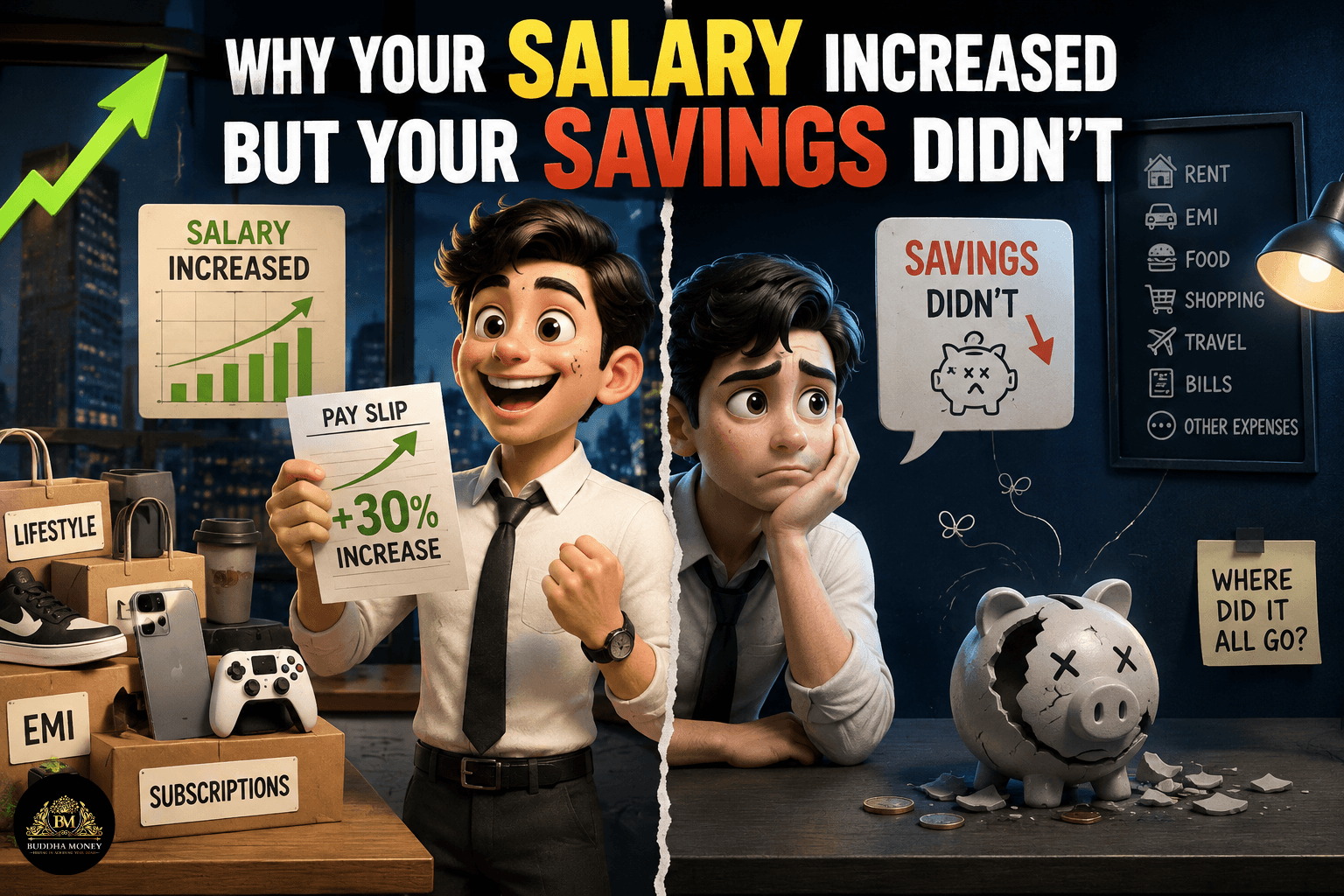
Your salary was ₹50,000 a month.
Then it became ₹70,000.
A few years later, perhaps it reached ₹1 lakh.
And today, you may be earning considerably more than when you started working.
But when you look at your bank balance or investments, there is an uncomfortable question:
“If my income has increased so much, why hasn’t my wealth increased at the same pace?”
This is more common than most people realise.
The problem isn’t necessarily that you are spending irresponsibly.
You may not be buying anything extravagant.
You may simply be upgrading your lifestyle every time your income improves.
A better phone.
A better car.
A more expensive apartment.
More frequent dining out.
More holidays.
Higher subscriptions.
More convenience.
More EMIs.
Individually, none of these decisions looks dangerous.
But together, they create something called lifestyle inflation.
And lifestyle inflation can quietly consume the very income growth that could have accelerated your wealth creation.
What Is Lifestyle Inflation?
Lifestyle inflation occurs when your spending increases as your income increases.
For example:
You earn ₹50,000 and spend ₹35,000.
Your monthly surplus is:
₹15,000
Then your salary rises to ₹80,000.
Instead of allowing your surplus to rise substantially, your expenses gradually increase to ₹60,000.
Now your surplus is:
₹20,000
Your income increased by ₹30,000.
But your monthly surplus increased by only ₹5,000.
This is the hidden problem.
Income increased by ₹30,000.
Wealth-building capacity increased by only ₹5,000.
The difference was absorbed by lifestyle upgrades.
The Most Dangerous Part: Lifestyle Inflation Doesn’t Feel Like Overspending
This is why lifestyle inflation is so difficult to recognise.
Most people don’t suddenly decide:
“My salary increased, so I’m going to waste all of it.”
Instead, the changes happen gradually.
First, you order food once a week.
Then twice.
Then ordering becomes normal.
You buy a ₹25,000 phone.
A few years later, ₹50,000 doesn’t feel unreasonable.
You move into a slightly better apartment.
Then upgrade your car.
Then add another subscription.
Then take more expensive vacations.
None of these decisions, individually, appears financially destructive.
The problem is cumulative.
Your definition of “normal spending” quietly changes.
A ₹50,000 Salary and a ₹1.5 Lakh Salary Can Have the Same Problem
Consider two hypothetical professionals.
Person A
Monthly income: ₹50,000
Monthly expenses: ₹35,000
Monthly investment: ₹15,000
Person B
Monthly income: ₹1,50,000
Monthly expenses: ₹1,25,000
Monthly investment: ₹25,000
Person B earns three times more.
But Person B invests only ₹10,000 more every month.
This doesn’t mean Person B is doing something wrong.
Perhaps Person B has genuine responsibilities:
- Housing
- Parents
- Children
- Education
- Insurance
- Transportation
- Lifestyle preferences
The point is different:
A higher income does not automatically create higher wealth.
The relationship between income, expenses and investments matters far more.
Your Salary Hike Can Disappear Without You Noticing
Suppose your monthly salary increases from:
₹80,000 → ₹1,00,000
That’s an additional ₹20,000 per month.
You might think:
“I’ll start investing the extra ₹20,000.”
But then reality happens.
₹4,000 goes toward a better phone EMI.
₹3,000 toward additional dining and entertainment.
₹5,000 toward a better car.
₹3,000 toward shopping.
₹2,000 toward subscriptions and convenience.
₹3,000 toward miscellaneous lifestyle expenses.
Your entire ₹20,000 salary increase has disappeared.
Your lifestyle improved.
But your financial position barely changed.
The EMI Trap
One of the biggest accelerators of lifestyle inflation is the EMI.
An EMI can make an expensive purchase appear affordable.
Suppose you couldn’t comfortably pay ₹6 lakh for a car.
But a salesperson tells you:
“Don’t worry. Your EMI is only ₹12,000.”
Suddenly, the purchase feels manageable.
Then another purchase comes with a ₹5,000 EMI.
Another adds ₹4,000.
Another ₹3,000.
Individually, they look small.
Together:
₹12,000 + ₹5,000 + ₹4,000 + ₹3,000 = ₹24,000 per month
That’s ₹2.88 lakh every year committed to EMIs.
And unlike an occasional expense, an EMI creates a recurring obligation.
This is why the right question isn’t simply:
“Can I afford the EMI?”
It is:
“Will this EMI reduce my ability to build the future I want?”
The ₹10,000 Lifestyle Upgrade Nobody Notices
Let’s look at a simple example.
Suppose your salary increases by ₹25,000 per month.
You decide to use:
- ₹10,000 for lifestyle improvement
- ₹15,000 for investing
That may not feel dramatic.
But ₹15,000 invested every month is:
₹1.8 lakh per year.
Over many years, that additional investment can become meaningful because the money has time to compound.
The important idea isn’t that you should never spend the additional ₹10,000.
You absolutely can.
The objective isn’t to eliminate enjoyment.
It is to ensure that your lifestyle doesn’t consume 100% of your income growth.
The 50-50 Salary Hike Rule
A simple behavioural framework can help.
Whenever your income increases, divide the additional amount.
For example:
50% → Lifestyle
50% → Wealth creation
Suppose your salary increases by ₹20,000.
You could allocate:
₹10,000 → lifestyle improvement
₹10,000 → additional investment
This gives you two benefits.
You enjoy the improvement in your income.
But you also ensure that every salary increase strengthens your financial position.
The ratio doesn’t have to be exactly 50:50.
For someone with major upcoming goals, perhaps 70% could go toward investments.
For someone who has been extremely restrictive for years, 40% might be more realistic.
The principle matters more than the exact percentage.
The Bigger Your Income Gets, the More Important This Becomes
Lifestyle inflation can become particularly significant as income rises.
At a lower income, most expenses are necessities.
At a higher income, more expenses become choices.
Consider the difference:
₹40,000 income
Most of your spending may be directed toward:
- Rent
- Food
- Transportation
- Bills
- Family requirements
But at:
₹1,50,000 income
you may have significantly more discretionary spending capacity.
That is where lifestyle inflation can accelerate.
The challenge isn’t earning more.
It is ensuring that your wealth-building rate increases along with your income.
Income Is Not Wealth
This distinction is extremely important.
Income
Money that comes into your life.
Savings
Money left after expenses.
Investments
Money deployed toward future wealth creation.
Wealth
The assets you have accumulated after accounting for liabilities.
Someone earning ₹2 lakh per month can have very little accumulated wealth.
Someone earning ₹80,000 can gradually build a substantial investment corpus if they consistently save and invest.
Therefore:
A high salary is an opportunity to create wealth. It is not wealth itself.
The Real Upgrade You Should Make With Every Salary Hike
When your income rises, most people upgrade their lifestyle first.
A better approach is to upgrade three things simultaneously:
- Your Lifestyle
Enjoy some of the additional income.
- Your Investments
Increase your monthly investment.
- Your Financial Protection
Review whether your insurance and emergency reserves remain appropriate as your income and responsibilities increase.
This creates a healthier relationship with income growth.
Why Automatic Investment Increases Work So Well
Human behaviour is predictable.
If additional money enters your bank account, you eventually find a use for it.
Therefore, instead of relying entirely on willpower, automate the increase.
Suppose your current SIP is:
₹20,000/month
Your salary increases.
Increase the SIP to:
₹25,000/month
Next year:
₹30,000/month
The increase may feel small relative to your salary.
But over a long period, these incremental increases can materially change the amount invested.
This is the basic logic behind a step-up SIP.
You don’t have to wait until you can invest a huge amount.
You can allow your investment to grow alongside your income.
The Difference Between Being Rich and Looking Rich
This may sound uncomfortable, but it is worth considering.
There is a difference between:
Increasing your lifestyle
and
Increasing your financial freedom.
A person may drive a ₹25 lakh car but have very little liquid wealth.
Another person may drive a modest car while having a substantial investment portfolio.
Neither is automatically right or wrong.
The question is:
Which one is closer to the life you actually want?
If your goal is financial independence, retirement security or creating a large corpus for future goals, then some portion of every income increase needs to be converted into assets.
Otherwise, your lifestyle may simply expand to absorb your earnings.
Lifestyle Inflation Is Not Always Bad
This is important.
You should not interpret this article as:
“Never spend more when you earn more.”
That’s unrealistic.
If your income increases, it is perfectly reasonable to:
- Eat better
- Travel more
- Upgrade your home
- Buy a better vehicle
- Enjoy hobbies
- Spend more time with family
- Improve your quality of life
Money is meant to support a meaningful life.
The problem begins when every increase in income is immediately converted into a permanent increase in expenses.
You want your lifestyle to rise.
But you also want your financial resilience to rise faster.
The Silent Cost of Lifestyle Inflation
Imagine two people.
Both receive a ₹30,000 monthly salary increase.
Person A
Uses the entire ₹30,000 for lifestyle upgrades.
Person B
Uses ₹15,000 for lifestyle and invests ₹15,000.
Person A enjoys ₹30,000 more every month.
Person B enjoys ₹15,000 more every month while putting the remaining ₹15,000 toward future wealth.
After ten years, Person B hasn’t merely invested ₹18 lakh of additional money.
That money has also had time to potentially compound.
The exact future value will depend on investment returns, but the principle is powerful:
The earlier you convert part of your income growth into investments, the longer that money has to work.
Don’t Let Your Fixed Expenses Rise Too Quickly
Variable expenses can often be adjusted.
Fixed expenses are more dangerous.
Examples include:
- Home loan EMI
- Car EMI
- Rent
- School fees
- Long-term subscriptions
- Recurring lifestyle commitments
When your fixed expenses rise sharply, your financial flexibility falls.
Suppose your salary is ₹1 lakh and your fixed commitments are ₹30,000.
You have substantial room to adapt.
But if your fixed commitments become ₹70,000, a temporary income disruption can become much more stressful.
Therefore, salary growth should ideally increase not only your spending capacity but also your financial margin of safety.
The “Future Me” Test
Before converting a salary increase into a permanent expense, ask yourself:
“Will I still be happy paying for this five years from now?”
A ₹3,000 monthly expense sounds small.
But that’s:
₹36,000 every year.
Over five years, ignoring investment returns, that’s:
₹1.8 lakh.
Now ask:
Would you rather spend it?
Or would you rather use some of it toward a goal that matters more?
There is no universal answer.
The important thing is making the decision consciously.
Give Every Salary Hike a Job
The next time your income increases, don’t let the money simply disappear into your regular bank account.
Give the additional income a purpose.
For example:
Salary increase: ₹20,000
₹7,000 — Lifestyle
₹8,000 — Long-term investment
₹3,000 — Emergency reserve / short-term goal
₹2,000 — Insurance / protection / other financial priorities
The allocation can be completely different depending on your circumstances.
But the principle is powerful:
Don’t let your salary increase become an invisible expense increase.
What If You Already Have Lifestyle Inflation?
Don’t try to reverse your entire lifestyle overnight.
That usually doesn’t work.
Instead, identify the expenses that have become unnecessary or disproportionately expensive.
Look at:
- Unused subscriptions
- Frequent food delivery
- Impulse shopping
- Expensive upgrades
- Multiple EMIs
- Unused memberships
- Frequent discretionary spending
- Lifestyle expenses that no longer provide meaningful value
You don’t need to cut everything.
Find the low-value expenses.
Then redirect that money toward your goals.
A Better Financial Progress Formula
Instead of thinking:
Income ↑ → Lifestyle ↑
Try to build this:
Income ↑
↓
Savings ↑
↓
Investments ↑
↓
Wealth ↑
↓
Financial freedom ↑
And yes, your lifestyle can increase along the way.
The goal isn’t deprivation.
It is intentional progression.
Five Questions to Ask After Every Salary Increase
The next time your income rises, ask yourself:
- How much of this increase will I actually save?
Don’t wait until the end of the month to find out.
- Can I increase my monthly investment automatically?
Even a modest increase can matter over time.
- Which lifestyle upgrade genuinely improves my life?
Not every upgrade is equally valuable.
- Am I increasing fixed commitments unnecessarily?
Be particularly careful with new EMIs.
- What financial goal can this additional income accelerate?
It could be:
- Retirement
- Children’s education
- Home purchase
- Emergency reserves
- Long-term wealth creation
- A major future expense
Giving money a purpose makes it easier to keep.
Final Thoughts
A salary increase should be more than a reason to spend more.
It should be an opportunity to move your financial life forward.
If your salary grows from ₹50,000 to ₹1 lakh but your lifestyle consumes almost the entire difference, you may feel richer without actually becoming significantly wealthier.
On the other hand, if every salary increase results in some combination of:
better lifestyle + higher investments + stronger financial protection,
your income growth begins to translate into genuine financial progress.
You don’t need to live an extremely frugal life.
You don’t need to sacrifice every experience.
You simply need to avoid allowing your lifestyle to automatically consume every additional rupee you earn.
Because ultimately, wealth is not created merely by earning more.
It is created by consistently converting a portion of what you earn into assets that can support your future.
And perhaps the most useful rule to remember is this:
When your income rises, don’t just upgrade your lifestyle. Upgrade your financial future too.
Frequently Asked Questions
What is lifestyle inflation?
Lifestyle inflation is the gradual increase in spending that occurs as income increases. Instead of allowing a larger portion of additional income to become savings and investments, people often use it to upgrade their lifestyle.
Is lifestyle inflation always bad?
No. Increasing your lifestyle as your income grows is not inherently wrong. The problem is allowing lifestyle expenses to consume almost all of your income growth, leaving little room for savings and investments.
Why does my salary increase but my savings remain the same?
This often happens because expenses increase alongside income. New EMIs, higher rent, more discretionary spending, subscriptions, travel and lifestyle upgrades can absorb salary increases before they reach your savings or investment account.
How much of a salary hike should I invest?
There is no universal percentage. A practical approach is to allocate a predetermined portion of every salary increase toward investments before increasing discretionary spending. A 50:50 split between lifestyle improvement and investing can be a useful starting framework.
Should I increase my SIP whenever my salary increases?
Increasing investments as income rises can be an effective way to prevent lifestyle inflation from consuming your entire salary increase. The appropriate amount depends on your goals, existing commitments, emergency reserves and overall investment strategy.
Is earning more the same as becoming wealthier?
No. Income is the money you earn; wealth is the assets you accumulate after considering liabilities. A higher income creates greater potential for wealth creation, but only if some of that income is consistently converted into savings and investments.
Key Takeaways
- A higher salary does not automatically mean higher wealth.
- Lifestyle inflation can quietly absorb salary increases.
- EMIs can make expensive lifestyle upgrades appear affordable.
- Don’t allow every salary hike to become a permanent expense increase.
- Consider automatically increasing your investments when your income rises.
- Protect your financial flexibility by controlling fixed commitments.
- Enjoying your income is important; so is securing your future.
- The goal isn’t extreme frugality—it is intentional allocation of income.
- Every salary increase should ideally improve both your present lifestyle and future financial position.
- Wealth creation begins when you consistently convert a portion of income into assets.
Disclaimer:
This article is intended for educational purposes only and should not be considered personalised investment, tax, insurance or financial advice. Individual financial decisions should be made after considering personal income, expenses, liabilities, goals, time horizon, risk profile and other relevant circumstances. Investment returns are subject to market risks, and past performance does not guarantee future results.